
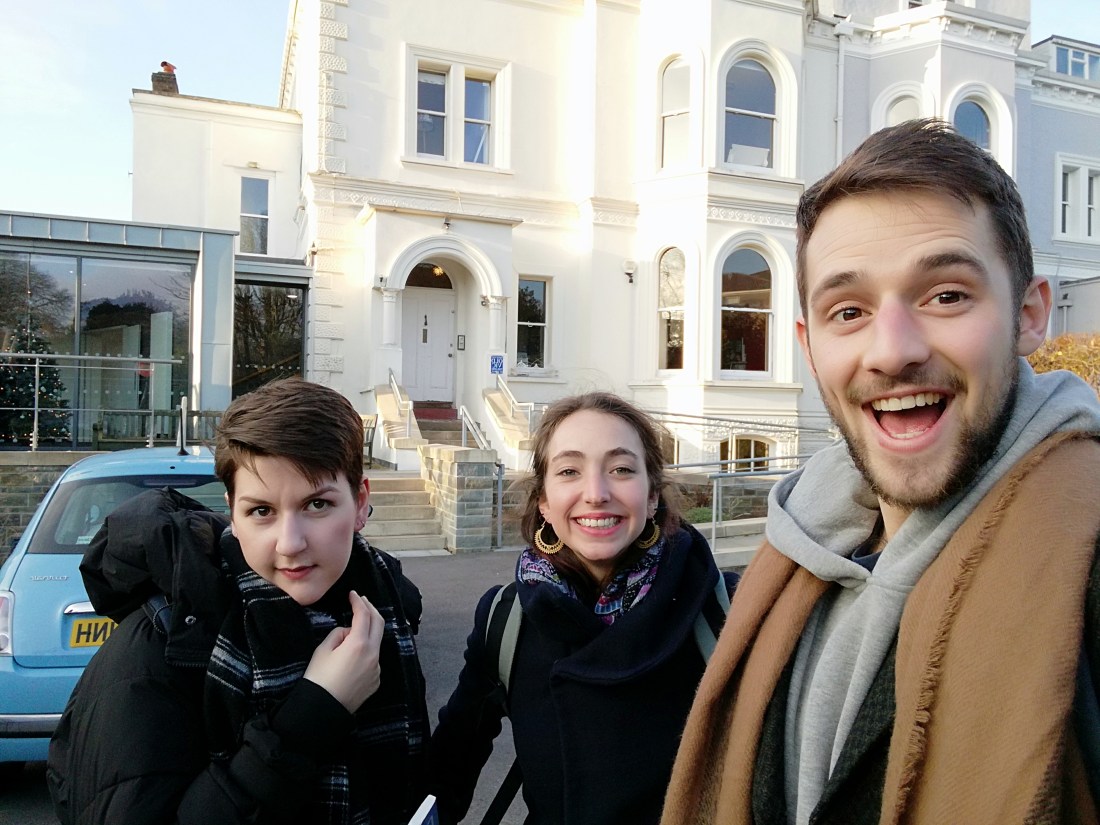
Just like that, the first twelve weeks of my training at Bristol Old Vic Theatre School is lodged in the books.
This term was akin to the first installment of a literary trilogy~ where we meet all the characters and get introduced to the primary, driving narrative (as well as a number of no-less-thrilling side adventures), but the book ends devoid of a satisfying resolution.
_________________________________________________
Being on a one-year program is a rather unusual learning framework. For most people going through (New Zealand) education systems (I am aware that this is a generalisation) secondary school is a five year process, a university degree typically takes three or four years, and even post-graduate courses are often a two year commitment. True, each year of learning at school or university has its own distinct flavour: steps up in the difficulty of the material, new mental and academic development, changes in personal goals; however it is a different process to be on a training program designed to imprint a rounded and thorough development in just a single year. Eleven months, actually.
104 days. Roughly 500 teaching hours.
Put like that, it doesn’t sound very long does it?
One might even find having to operate within such a condensed timeline,
stress-inducing.
This cause & effect of stress is what I have been reflecting on since school broke up for a three-week Christmas break last Friday:
‘the problem with viewing our training through a specific time-frame’.
________________________________________________________
It is probably not surprising for me to say that at times conservatoire training can be overwhelmingly stressful.
There are individual stresses, born out of pursuing individual goals, struggling to meet often hyper-critical personal expectations, experiencing daily difficulties with exercises or activities, general physical and mental well-being, and the overall intensity of the training. Equally, there are group stresses that grow out of the simple fact that spending forty hours a week with the same fourteen people for three months can lead to a sometimes tense environment. Differences in habits and learning processes seem more pronounced when you spend such significant time with a small group.
But I think that the primary cause of stress among my fellow MA Acting students and I,
is facing new, genuine, challenges within (what feels like) a time-sensitive course.
____________________________________________________
First, the ‘genuine challenges’ part of this equation.
I certainly wasn’t naive to the fact that training at one of the most well-regarded acting schools in the world was going to be hard. I expected it to be intense in every sense of the word: physically tiring, mentally stimulating, emotionally exhausting. But expecting these difficulties and actually going through them are two very different things.
I also think that it is utterly truthful to say that each individual on my course is immensely talented. There is, after all, a reason why BOVTS offered them a place on such a highly-selective program. However, a difficulty accompanies this presence of individual ability: most of us are used to being leaders & ‘succeeders’ in some form within our home theatrical communities. We are used to excelling, picking things up quickly, having a strong presence in a rehearsal room and (often) being the first person to understand a dramatic concept or idea.
But here at Bristol Old Vic, we are challenged in ways that we haven’t been before. There is a sort of evening-out that occurs amongst everyone.
The training is elevated. The concepts are more in-depth. The physical demands are more rigorous. The hours are longer. The expectations are higher. And all this means that when things don’t go perfectly, when we struggle with something, it becomes all the more confronting because we aren’t used to asking ourselves ‘why isn’t this working for me‘?
It’s one thing to learn not to compare yourself to your fellow practitioners; its another thing entirely to learn not compare yourself to your own expectations of yourself.
______________________________________________
The second half of the equation is the omnipresent, lingering sense of limited time.
Only being at Bristol Old Vic for one year can a stressful thought. There is often a nagging thought of questions like ‘will we pack it all in?’, ‘will I get better at this skill before its all over?’, ‘am I in a race against time to better myself while I have the tutorship and institution around me?’.
These questions are incredibly counterproductive to creative development.
It is certainly true that our MA Acting training is condensed, in that we spend a year at the school, whereas the BA students spend three years; however the school does a fantastic job at trying to remove any sense of timelines from the training. We never hear “do x amount of monologue work by week 7”, or “be better at this dance move by tomorrow”. Instead the focus is directed towards being present in every hour-long class, absorbing what you can in that particular moment, and (hopefully) looking forward to the next opportunity to explore that concept/skill/exercise further.
Yet despite this way in which the school emphasises a continues flow to our learning, I think the tendency for students (regardless of where we are in our creative development and/or career trajectory) is to constantly worry about whether we will better ourselves in a certain period of time. This self-assessment inevitably leads to stress, and the stress ultimately affects one’s enjoyment of the learning. How completely counterproductive…
_________________________________________________
As I said in a previous post, the development of an actor never ends.
The training I am engaging in now is merely the start of what will hopefully be a lifetime of work. So it seems incredibly silly to allow the fear of ‘not developing quickly enough’ to sap the joy out what is a wonderfully privileged situation for a young actor.
My classmate Brian Pater visualised this predicament rather well, likening our learning development to trying to hold a handful of sand at the beach:
“the tighter you grasp and squeeze the sand in an attempt to hold onto it, the quicker it will run through the cracks in your fingers”.
In response to that I say:
Hold the sand loose and simply enjoy being at the beach, knowing you have the freedom and ability to scoop up another handful of sand when the first runs out.
______________________________________________
Thank you to anyone who has read my blog posts this year, I hope to keep them coming in 2019.
Merry Christmas to you all!
xx
JCL
 "Doing The Work"- Reflections on Drama School.