
This second Term at Bristol Old Vic Theatre School has been…manic. A gloriously chaotic three months of refining, rehearsing, not-sleeping and new learning. Sadly, the even greater work-load has translated into a fairly piss-poor effort on the blog post front; however, now that the holidays are almost here, I will try to make up for lost time!
_______________________________________________
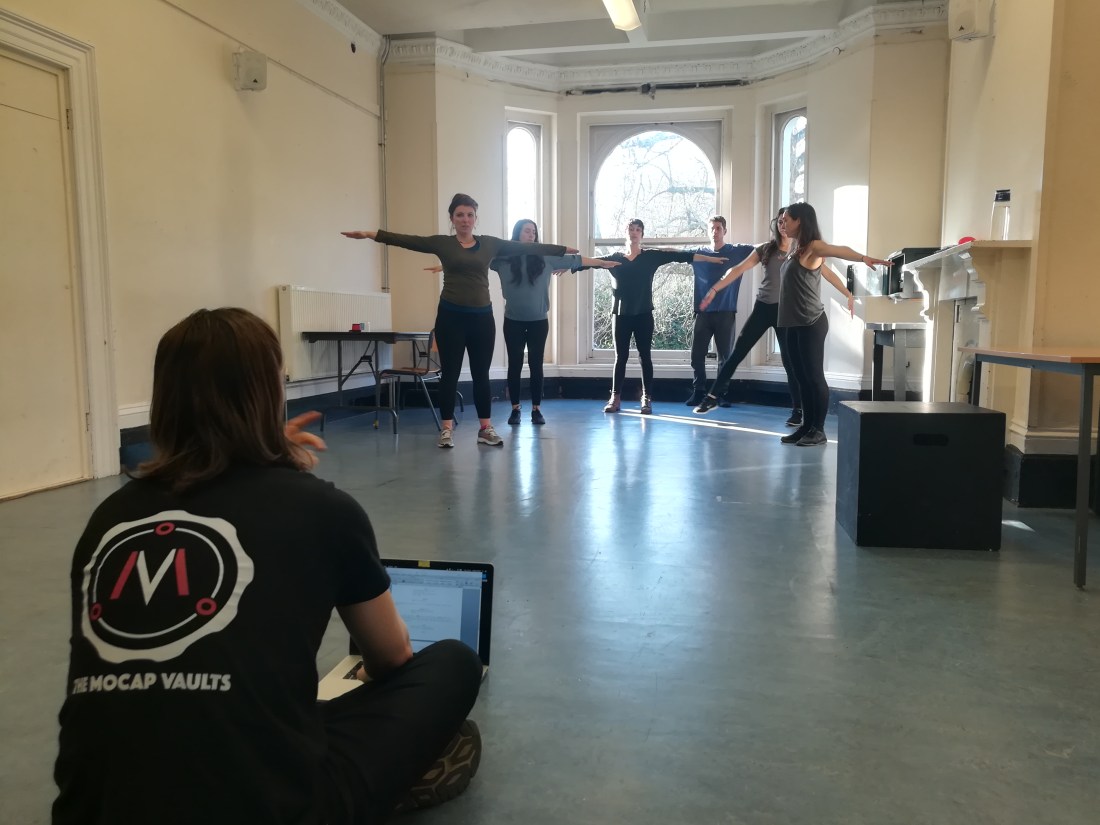
It is currently our last week of classes before a three week holiday, and our MA class has just finished a two-day intensive workshop with the brilliant Paul William Mawhinney of ‘The Mocap Vaults’ – a world renowned Motion Capture training company.
It would be impossible to effectively condense sixteen hours of Motion Capture education into pure writing, so I will simply try to ‘pen’ some of the key features of our two-day workshop.
Motion Capture.
One of the very first things we learnt from Paul, is that the term ‘motion capture’ is actually slightly misunderstood by the general public. Most of what you think you know about ‘MoCap’- the funny suits covered in balls, absurd animal impersonations, head-mounted cameras- is all fairly accurate to the craft. However in its popular vernacular usage, ‘motion capture’ is often confused with what is referred to in the industry as ‘full performance capture’.
Quite simply- ‘full performance capture’ is when an actor’s physical movements, facial movements and voice are all captured simultaneously by data-tracking cameras to be used for animating a character- be it in film, television, adverts or video gaming.
‘Motion capture’ is when just the actor’s physical movements are captured. Andy Serkis’ iconic performance in the role of Gollum in The Lord of The Rings would classify as ‘full performance capture’, as Serkis was responsible for portraying every aspect of that character. Say, for example, Serkis had done all the crawling, prowling, and jumping for Gollum’s character, but (as a random example) Patrick Stewart had provided the voice for the role in recording booth sessions, Serkis would be described as having done ‘motion capture‘ for the role.
*This being said, within the rest of this blog post I will continue to use the term ‘motion capture’ as a general blanket term for both MoCap and full performance capture.
The Three Kinds of Motion Capture Technology.
There are three main strains of Motion Capture technology used across the entertainment industries. The first, and most well-known, is called ‘Optical’ or ‘Line of Sight’. This form is the most expensive, but produces the most specific and accurate data for film and game companies to work with. Long story, short: the MoCap performer wears a tight suit with lots of reflective balls on it. In a big, largely empty warehouse space dozens of infrared cameras capture the movement/change in space of the suit-balls in relation to each other. The camera data is then sent to computers which used software to replicate the skeletal shape of the MoCap performer. Brilliantly talented animators then do their thing, and the skeletal movement data can be manipulated and used to create fully-formed 3D graphic characters. Crucially to the Optical system- if the cameras can’t see the balls on the performer’s suit, then they can’t send data back to the computers. No folding your arms!
The second form of MoCap technology is ‘Kinaesthetic’. Slightly cheaper to operate than Optical, Kinaesthetic uses a similar ‘suit and ball’ system, however the tracking software is inside the balls themselves. Unlike Optical, where cameras do the tracking, the data is captured by the Kinaesthetic balls tracking how close or far away they are to each other (and therefore the relative body parts) to create a digital skeleton.
The final form is ‘Markerless’. This is used by lower budget productions, and components of this tech can be found on high-end smart phones. Think iPhone Animoji- the newest, most complex version of what began as Snapchat filters. This software can track how your face moves, and use that data to animate emoji creatures that posesses your facial habits.
Locomotive MoCap vs. Cinematic MoCap.
There are two main types of work a motion capture performer can do (in terms of how their work will be used by the production company that they are creating a character for)- ‘locomotive’ motion capture, and ‘cinematic’ motion capture.
The cinematic variety is typically what we typically think of most when imagining motion capture- an actor donning the suit, crawling around and saying the lines for a character, which is then graphically edited in post-production to create some (generally) non-human visual onscreen. Think Benedict Cumberbatch as Smaug, or War of the Planet of the Apes. In a sense, ‘cinematic’ MoCap is like shooting a normal film- actors perform in character, generally with dialogue, which gets edited and is used in the final cut of the film.
‘Locomotive’ MoCap, however, is more specific to the gaming medium. Unlike movies, modern games (at least ones that use MoCap in their development) require more than just scenes to create the final, consumable product. In-game characters are manipulated by the human player- running, jumping, attacking, using weapons, turning etc- in hundreds of different variable ways. So in order for a game to be able to have all these movements and actions available to a player, the game designers need to have the motion captured data of how each character completes these actions. Which means… a motion capture performer has to record
Every. Single. Version. of. Every. Single. Movement. a character could need…
Now of course lots of game-play is repetition- for example, a character generally walks in the same way. And of course, not all gaming companies can afford to use motion capture technology in making their games, but you can see how the ones that do require A LOT of hours of performance work from their motion capture performers.
Base Pose / Idles / Idle Inserts
As I said at the top, there is far too much information to put into a blog post, however I want to quickly explain some of the actual motion capture performance work we did within our workshop- as a taster for the kind of physical acting required to be a motion capture performer.
When recording ‘locomotive’ motion capture’an actor will have what is called a ‘base pose’ for his or her character. Think the default position that a video game character adopts when it isn’t doing anything. To be incredibly generic- a dwarf might be hunched, a pirate might be slouched, Spider-Man might be on the balls of his feet.
The first step a MoCap actor has to take in creating a character is to figure out it’s base pose. How does he/she/it stand. How confident am I? What is my posture like? How symmetrical is my body? Where do I hold my tension? Every character will be unique, just as every creature and person in reality is unique, however generalisations are your friend in motion capture. Base Pose is not about creating a nuanced performance- it is about finding a way to hold your skeleton that will A) effectively get you, the actor, into the body of the role you are playing, and B) give the data-capturing cameras a default state from which every physical change in your performance/character can be measured against.
An idle is the next stage on from a base pose- how does your character hold itself in different emotional states? For example, if a performer had to do MoCap for Spider-Man, the idle for Peter Parker and Spider-Man would be drastically different. The game developers would also likely need a ‘combat idle‘- how Spider-Man holds himself in a stationary state when he is about to fight. Or a ‘stealth idle’, for when he is about to crawl around behind unsuspecting enemies. All these states-of-being have to be fully realised, incredibly specific and memorised such that the performer can go back to them over and over again for different takes. I won’t elaborate any further, but if you can process just how complex this sounds just to create the data needed for a video game character to stand still…think how much time and effort goes into capturing the data for every jump, turn, weapon attack, crouch, physical reaction and movement of a fully fledged character…
It is a lot of work, but fun as hell!!!
______________________________________________________
I hope this has been an interesting, albeit not-too-wordy insight into the very basics of Motion Capture performance. Our two days working with Paul from MoCap Vaults were truly incredible. Learning just how specific and meticulous an actor has to be to effectively perform MoCap was a massive learning curve. I had such a blast and I hope to take my MoCap training further by doing more training courses with the MoCap Vaults company in London in the near future.
…and hopefully don the suit…
JCL
 "Doing The Work"- Reflections on Drama School.